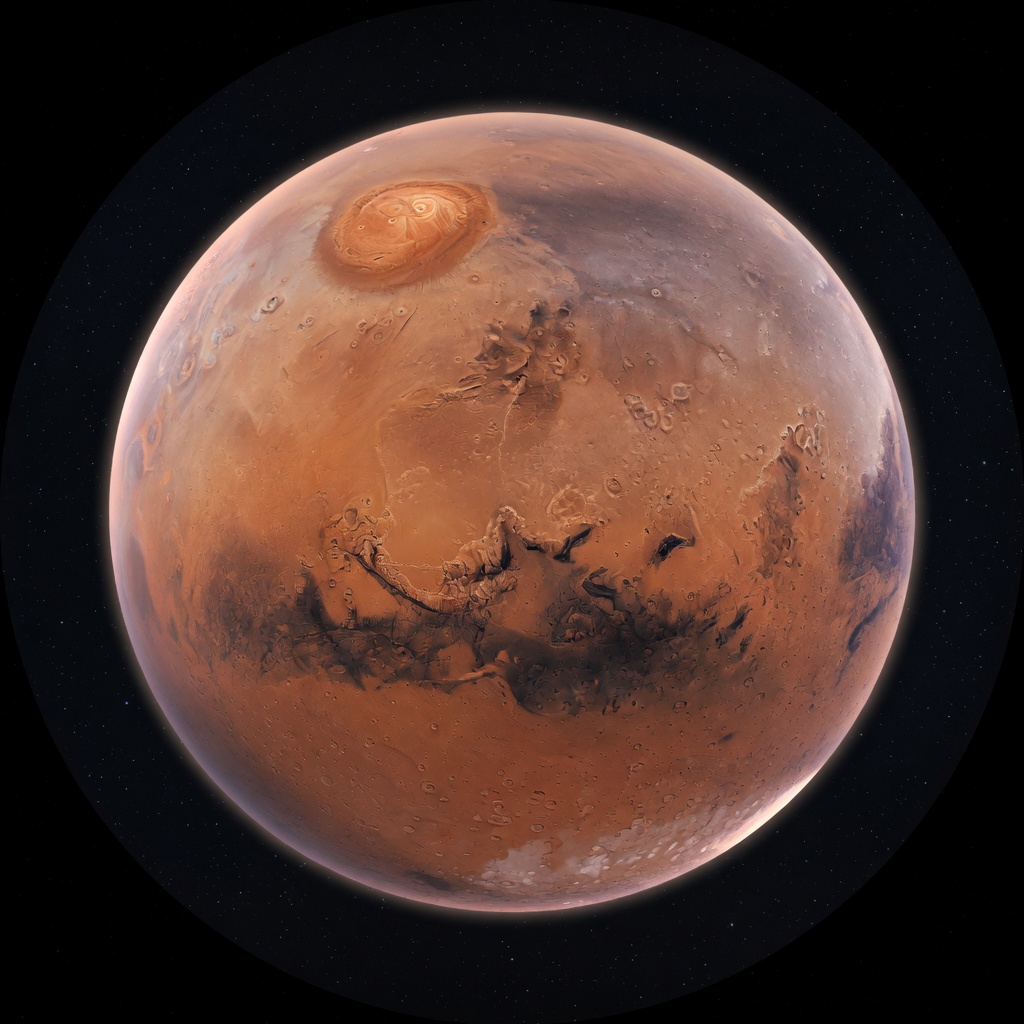
Yinghuo (荧惑); Huoxing (火星 Fire Star); Faxing (罚星 Punishment Star)
Flickering fire + confusion; portent of rebellion
Pre
Indian (Sanskrit)
Mangala, Angāraka, Kuja / Bhauma, Raktavarṇa
Red/charcoal one; earth-born; war energy; Tuesday
Pre
Arabic / Islamic
al-Mirrīkh (المريخ)
Standard Arabic planetary name; warrior imagery
Post
Persian
Bahram
Planetary name linked to martial deity tradition
Post
Japanese / Sinosphere
Kasei (火星), from Chinese Fire Star
Fire element / red planet
Post
The oldest durable story about Mars is almost universal: red = blood/fire → war, fever, plague, chaos. The redness is naked-eye fact first; myth follows color.
Nergal
CAT-NAME-001
Before Jesus Mesopotamia · God + planet
Nergal (Sumerian dGÌR-UNUG-GAL and related writings) was worshiped through all periods of Mesopotamian history as lord of the underworld, plague, fever, war, and sudden death. Cult center: Kutha. Symbols include lion-headed mace, sword, lion, bull. Mesopotamian astrologers identified the red planet with him — the association of the “dark” underworld lord with the dark-red color of Mars, and of red with blood and fire, made the identification natural. Also conflated or paralleled with Erra (destruction), Resheph in the west, and Elamite Simut.
MUL.GIG, Makrû, red & hostile stars
CAT-NAME-002
Before Jesus Akkadian astronomy
Beyond the god-name, Mars carried descriptive star-names: red star, unpredictable star (kakkab la mināti — “changes its place all year round”), false star, strange star, hostile, rebellious, pestilence, star of Elam, star of Eridu. The Great Star List paints Nergal/Mars as false, sinister, liar, enemy, and the destructive Panther star. These are not poetic nicknames only — they are omen vocabulary.
Simut
CAT-NAME-003
Before Jesus Elam
Elamite warrior god who shared Nergal’s association with the planet Mars. Important for understanding that the “war/plague planet” pattern was regional, not only Babylonian.
Horus the Red (Her Deshur)
CAT-NAME-004
Before Jesus Egypt
The planet was known as Horus of the Horizon, then later Her Deshur (“Horus the Red”). Mars, Jupiter, and Saturn could all be Horus-aspects; Mars is the color-marked one. Ties into royal falcon cosmology and Horus’s martial struggle with Set — less “underworld plague” than Egypt’s own solar-royal war language tinted red.
Ma’adim (מאדים)
CAT-NAME-005
Before Jesus Hebrew
Pure observation: “the one who reddens.” Later fixed in Talmudic planetary lists (e.g. Shabbat 156a context of classical planets). No full national Mars cult like Babylon or Rome; the name survives into modern Hebrew and even planetary cartography (Ma’adim Vallis on Mars).
Ares · Areos aster · Pyroeis
CAT-NAME-006
Before Jesus Greece
In Plato’s age the planet is Ἄρεως ἀστήρ — star of Ares. Hellenistic Greeks also called it Πυρόεις (Pyroeis), “the Fiery.” Ares himself is the Olympian of battle-lust and chaotic war (contrasted with Athena’s strategy). Whether Greeks equated Nergal with Ares directly or both drew from deeper Near Eastern patterns remains debated; the planetary temperament (hot, dry, violent) is the durable Greek inheritance into astrology.
Mars · stella Martis
CAT-NAME-007
Before Jesus Rome
Latin translation of the Greek planetary name via interpretatio: Ares → Mars. But Roman Mars is not merely Ares rebranded: he is father of Romulus and Remus, god of war and agriculture, ancestral protector of the state. Month: Martius (March). The modern English “Mars” and the astronomical name are this Roman form. Symbol ♂ (shield + spear) later standardizes in late antique / Byzantine transmission.
Yinghuo · Huoxing · Faxing
CAT-NAME-008
Before Jesus China
Yinghuo (荧惑): flickering like distant fire + confusion and disorder — attested in early texts such as Lüshi Chunqiu and discussed in Sima Qian’s Records of the Grand Historian. After Five-Phases theory: Huoxing 火星, Fire Star (still modern Chinese). Also Faxing 罚星, Punishment Star. Yinghuo’s erratic motion = harbinger of rebels, disease, death, hunger, war; lingering months can mean fall of a state.
Mangala · Angāraka · Kuja · Bhauma
CAT-NAME-009
Before Jesus India
In Hindu literature Mars is personified as Mangala; Angāraka (“red/charcoal one”); Kuja / Bhauma (“earth-born”); Raktavarṇa (blood-colored). Skanda Purana traditions include birth from Shiva’s sweat; Vaishnava lines link to Bhumi and Varaha. Iconography: red or flame-colored, four-armed (trident, mace, lotus, spear), mount a ram, day Tuesday (Mangalavara). Less “underworld plague” than martial heat, courage, and dangerous vitality.
al-Mirrīkh (المريخ)
CAT-NAME-010
After Jesus Arabic / Islamic world
Standard Arabic name for Mars. In medieval Islamic art and astrology, Mars is personified as a warrior holding a sword and often a severed head — temperament and occupation made visual. Used in zīj tables, horoscopes (including foundation lore of Baghdad and Cairo), and scientific works from al-Khwārizmī to al-Bīrūnī.
Bahram
CAT-NAME-011
After Jesus Persian
Persian planetary name for Mars, continuous with older Iranian martial and celestial traditions, used alongside Arabic scientific vocabulary in the broader Islamic world.