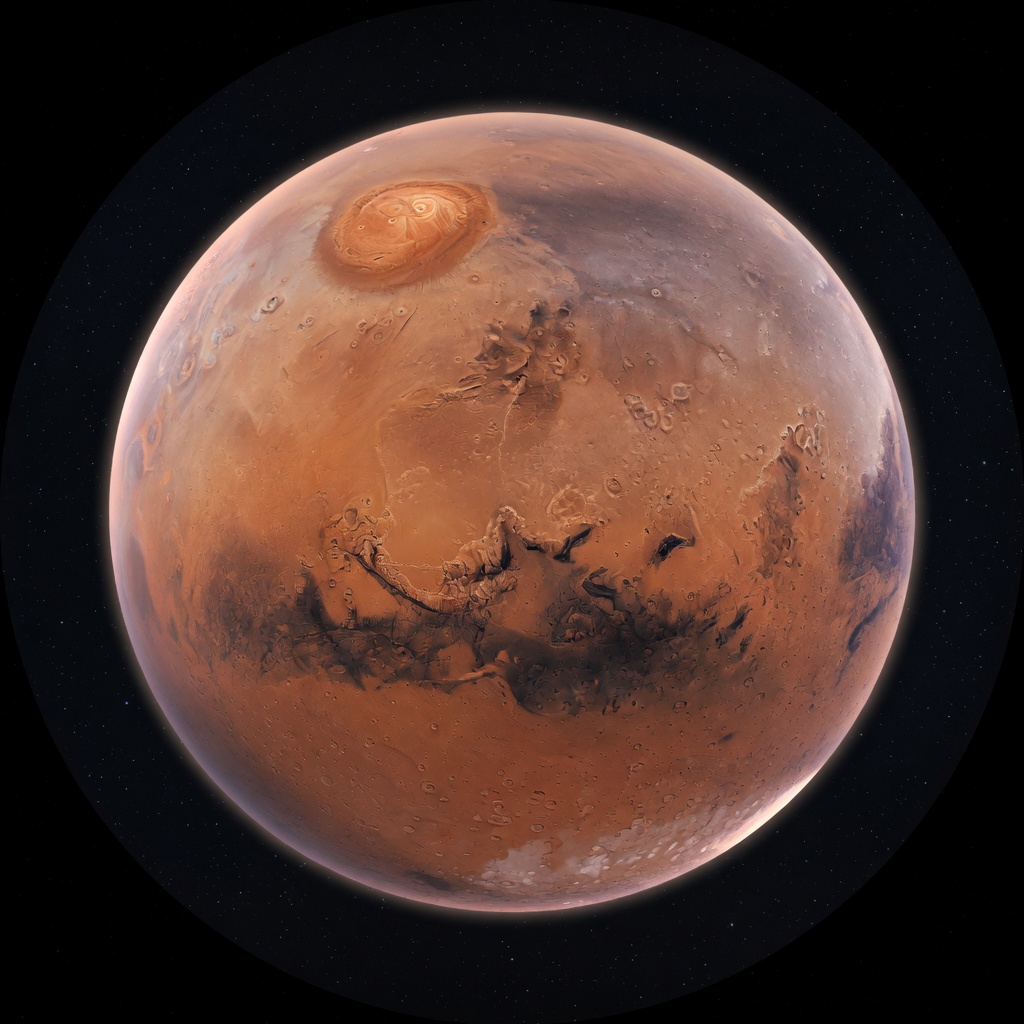
One entry at a time. The year, the place, what they thought the red light meant, and a line they left.
Before the year 1
c. 2000–500 BCE · Mesopotamia
Nergal and the Red Star of Pestilence
The earliest sustained written tradition linking a visible red wanderer in the sky to a named god of war, plague, and the underworld.
From the Early Dynastic period through the Neo-Babylonian empire, Nergal (Sumerian: dGÌR.UNU.GAL) was worshiped at Kutha as a god of war, destruction, and death. In the late Babylonian astral-theological system he was identified with the planet Mars (Akkadian Ṣalbatānu). Omen series such as Enūma Anu Enlil and the handbook MUL.APIN treat planetary appearances, stations, and color as messages from the gods. Mars was linked with disease (including kidney disease in medical-astrological texts) and with military disaster—exactly the portfolio of Nergal. When the planet brightened, reddened, or stood in ominous positions, scribes recorded omens of death, revolt, and plague for the king and the land.
What they read in the light. Reddening, brightening, stationary points, and path of Mars interpreted as Nergal’s will: war, plague, death of kings, and land disasters.
Names on this record. Ṣalbatānu (Akkadian): Mars (planetary); Nergal (Sumerian/Akkadian): God of war & underworld
Ṣalbatānu… [is] Nergal; when Mars is red like blood, the land will see death.
Mesopotamian planetary omen tradition (Enūma Anu Enlil type) · Akkadian (paraphrased from omen tradition)
Wording varies across tablets; the association of red Mars with death and Nergal is standard in the corpus.
Egyptian astronomer-priests named the red planet after Horus in his red aspect—linking color, kingship, and the sky.
Egyptian planetary nomenclature treated the five naked-eye planets as manifestations of Horus or other sky deities. Mars appears in texts as Ḥr-dšr (‘Horus the Red’) and in some contexts as a form of Horus of the Horizon. Unlike Mesopotamia’s heavy emphasis on disaster omens, Egyptian references are more cosmological and calendrical, but the red color of the planet was explicit in the name. Later Greco-Egyptian and Demotic sources preserve these names alongside Greek Pyroeis.
What they read in the light. The planet’s red color was encoded in its divine name; Mars as a face of Horus in the night sky.
Names on this record. Her Deshur (Egyptian): Horus the Red
Horus the Red (Mars)
Egyptian planetary nomenclature · Ancient Egyptian
Horus of the Horizon (used in some planetary lists for Mars)
Astronomical temple & papyrus traditions · Ancient Egyptian
c. 1000 BCE – present · India
Maṅgala / Aṅgāraka — India’s Burning Coal
In India the red planet is Maṅgala—also Aṅgāraka, ‘the burning coal’—a Navagraha deity of war, energy, and Tuesday.
Sanskrit planetary theology personifies Mars as Maṅgala (मङ्गल), Aṅgāraka (अङ्गारक, ‘charcoal / ember’), Kuja, and Bhauma (‘son of Earth’). Iconography paints him red or flame-colored, often four-armed, mounted on a ram, bearing weapons. In Jyotiṣa (Hindu astrology) he rules courage, conflict, siblings, and land; his weekday is Mangalavāra (Tuesday). Classical texts and later purāṇic stories elaborate his birth and fierce temperament. While not primarily an ‘omen of empire collapse’ tradition like China’s Yinghuo, Mars’s red color and martial character are explicit in name and cult.
What they read in the light. Red color → ember and blood; planet as warlike deity governing conflict, strength, and Tuesday.
Names on this record. मङ्गल Maṅgala (Sanskrit): Mars / auspicious; अङ्गारक Aṅgāraka (Sanskrit): Burning coal; भौम Bhauma (Sanskrit): Son of Earth
Aṅgāraka — ‘the red/burning one’ (Mars)
Sanskrit astronomical & purāṇic usage · Sanskrit
Maṅgala — Mars; also ‘auspicious’
Navagraha tradition · Sanskrit
Om Ang Aṅgārakāya Namaḥ — salutation to Angaraka (Mars)
Traditional Mars mantra (Navagraha) · Sanskrit
c. 800–100 BCE · Greece
Ares and Pyroeis — Greece’s Fiery Planet
Greeks named the planet for Ares (or called it Pyroeis, ‘the Fiery One’) and filled literature with the god’s blood-red rage—even as poets despised him.
In myth, Ἄρης (Ares) is the god of brutal battle. Homer’s Zeus calls him the most hateful of the Olympians. Astronomically, Greeks used Πυρόεις (Pyroeis) for the planet’s fiery appearance. Hellenistic astronomers (including Hipparchus and later Ptolemy in the Almagest) tracked Mars’s difficult retrograde motion. The Greek inheritance of Babylonian planetary data, filtered through Alexandria, made Mars a scientific problem as much as a mythic one.
What they read in the light. Red color → fire and blood; planet as Ares’s star; irregular path seen as warlike and hard to predict.
Names on this record. Ἄρης (Ares) (Greek): God of war; Πυρόεις (Pyroeis) (Greek): The Fiery One
To me you are the most hateful of all the gods who hold Olympus. Forever quarrelling is dear to your heart, wars and battles.
Homer, Iliad 5.890–891 (Zeus to Ares), tr. after Lattimore · Ancient Greek (Homeric)
The Fiery One (planet Mars)
Greek astronomical nomenclature · Ancient Greek
Ares, Ares, bane of mortals, bloodstained stormer of walls
Homer, Iliad 5.31 · Ancient Greek
c. 700 BCE – 400 CE · Rome
Mars — Rome’s Patron of War and the Red Planet
Romans elevated Mars above Ares’s Greek reputation: father of Romulus, guardian of the legions—and namesake of the planet still called Mars today.
Mars was central to Roman identity: mythical father of Romulus and Remus, honored in the Campus Martius, and invoked before campaigns. The planet’s blood-red hue matched his martial cult. Latin poets and later encyclopedists treat the planet as stella Martis. The weekday dies Martis (French mardi, Spanish martes) preserves the identification. When Rome absorbed Greek astronomy, Pyroeis became Mars without losing the Roman god’s prestige.
What they read in the light. Planet named for the war god; red color read as blood and iron; omens of Mars used in military and imperial propaganda.
Names on this record. Mars / Mārs (Latin): God of war; Mars Ultor (Latin): Mars the Avenger
Father Mars, I pray and beseech you that you be willing and propitious to me, to my house and to our household…
Cato the Elder, De Agri Cultura 141 (prayer to Mars) · Latin
the star of Mars (the planet)
Roman astronomical & poetic usage · Latin
I sing of arms and the man… (epic of war under Mars’s sphere)
Vergil, Aeneid 1.1 — opening of Rome’s national epic of war and foundation · Latin
The Aeneid is not about the planet, but situates Roman destiny under martial destiny and the gods of war.
c. 400 BCE – 1912 CE · China
Yinghuo — China’s Fire Star of Chaos
Chinese court astronomers kept the longest continuous written watch on Mars—as Yinghuo (荧惑), the ‘confusing fire,’ omen of rebellion, famine, and the death of emperors.
Ancient Chinese associated the red planet with the Fire phase (火) and the south. An older name, 荧惑 (Yinghuo), describes a dim, flickering fire that causes confusion—matching Mars’s changing brightness and retrograde loops. Sima Qian’s Records of the Grand Historian (c. 100 BCE) codifies the dread: Yinghuo forecasts chaos, rebels, disease, death, hunger, and war. The most feared configuration was 荧惑守心 (Yinghuo shǒu Xīn)—‘Mars guarding the Heart’ mansion (near Antares in Scorpius), read as a threat to the emperor’s person. Imperial annals across two millennia record such stations, often near succession crises or rebellions. Mars was also called 罚星 (Fáxīng), the Punishment Star—Heaven’s chastisement of misrule.
What they read in the light. Retrograde loops, color changes, and especially Mars stationing in the Heart lunar mansion (Xin) → death of rulers, dynastic chaos, war, famine.
Names on this record. 荧惑 Yinghuo (Chinese): Fitful / confusing fire; 火星 Huoxing (Chinese): Fire Star; 罚星 Faxing (Chinese): Punishment Star
Yinghuo forecasts chaos, cruel rebels, disease, death, hunger, and war.
Sima Qian, Shiji (Records of the Grand Historian), Treatise on the Celestial Offices · Classical Chinese
When it moves backward twice and stays, disaster will strike… If it lingers, calamity returns; one must not raise arms or wage war.
Shiji / Han astronomical omen tradition on Yinghuo · Classical Chinese (Shiji tradition)
Mars (Yinghuo) guarding the Heart [mansion] — omen of extreme danger to the sovereign
Imperial astronomical records across dynasties · Classical Chinese
Punishment Star (Mars as Heaven’s chastisement)
Chinese astronomical nomenclature · Classical Chinese
After the year 1
c. 600–1800 CE · Japan
Kasei — Japan and the Fire Star
Japanese court astronomers adopted Chinese planetary names and omen logic: Mars as 火星 (Kasei), the Fire Star of disorder.
From the Asuka and Nara periods, Japanese official astronomy was modeled on Tang Chinese systems. Mars appears as 火星 (Kasei). Chronicles record unusual planetary phenomena in the same omen vocabulary as Chinese sources—guest stars, comets, and planetary stations interpreted for the court. While Japan developed distinct onmyōdō practices, the Mars-as-fire association and cautionary reading of red planetary anomalies remained part of elite skywatching.
What they read in the light. Fire-star anomalies and unusual brightness/path of Mars read as signs affecting the realm, following Chinese precedent.
Names on this record. 火星 Kasei (Japanese): Fire Star
Kasei — Fire Star (Mars)
Japanese astronomical nomenclature · Japanese (kanji)
Keikoku — the confusing fire (classical loan name for Mars)
Sino-Japanese astronomical vocabulary · Japanese reading of Chinese Yinghuo
c. 800–1200 CE · Islamic World
al-Mirrīkh in the Islamic Golden Age
Arabic and Persian astronomers refined Mars’s orbit, built observatories, and wrote zījes—while astrologers like Abū Maʿshar made Mars a planet of war and heat in the Islamic sciences.
Under the Abbasids, Greek, Indian, and Persian astronomy were translated into Arabic. Mars (المريخ) appears throughout zījes (astronomical tables): al-Khwārizmī’s Zīj al-Sindhind, al-Battānī’s tables, Ibn Yūnus’s al-Zīj al-Ḥākimī (with observed planetary conjunctions), and al-Bīrūnī’s al-Qānūn al-Masʿūdī on planetary motions. Observatories in Baghdad, Cairo, Rayy, and later Maragha and Samarkand tracked Mars’s difficult path. Parallel to mathematical astronomy, judicial astrology (aḥkām al-nujūm) treated Mars as hot, dry, and martial—ruler of Tuesday and of conflict. Abū Maʿshar (Albumasar) of Balkh, the most influential astrologer of the Abbasid court, transmitted these doctrines to Latin Europe. al-Ṣūfī’s Book of the Fixed Stars (964) did not map planets as constellations, but the manuscript culture of Islamic astronomy framed the entire planetary sky—including Mars—with Arabic precision.
What they read in the light. Mars as both a calculable planet in mathematical astronomy and a significator of war, heat, and strife in astrology.
Names on this record. المريخ (Arabic): Mars; النجم القاهر (Arabic): The Subduing Star
Mars is the fourth planet in distance from the Sun…
Standard Arabic astronomical description (classical tradition continued) · Arabic (modern descriptive style rooted in classical usage)
The great Abbasid-court astrologer whose works on planetary meanings (including Mars as martial) shaped medieval Europe
Biographical tradition; Latin translations of his Great Introduction · Arabic / Latin Albumasar
zīj — astronomical handbook with tables for Sun, Moon, and planets including Mars
Islamic astronomical genre (e.g. Ibn Yūnus, al-Battānī) · Arabic
969 CE · Islamic World
al-Qāhira — Cairo Named for the Subduing Star
When the Fatimids founded their new capital in Egypt, tradition holds that Mars—al-Najm al-Qāhir, the Conquering Star—was rising. The city became al-Qāhira: Cairo.
In 969 CE, Fatimid general Jawhar al-Siqilli founded a new royal city north of Fustat for Caliph al-Muʿizz. Arabic sources and later historiography connect the name القاهرة (al-Qāhira, ‘the Vanquisher/Conqueror’) with the planet Mars, known as النجم القاهر (al-najm al-qāhir) or simply القاهر (al-Qāhir). One famous narrative has laborers waiting for an astrologically elected moment; when a raven alighted on the foundation rope and bells rang as Mars reached a critical place in the sky, the city took the planet’s epithet. Whether the raven story is legend or not, the linguistic and astronomical link between Cairo’s name and Mars is a standard part of the city’s etymology in Arabic tradition. Mars in Arabic is also المريخ (al-Mirrīkh) and المحرق (al-Muḥarriq, ‘the Burner’).
What they read in the light. Foundation of a capital city timed to / named for Mars as the Subduing Star — an auspicious martial omen, not a disaster omen.
Names on this record. المريخ al-Mirrīkh (Arabic): Mars; القاهر al-Qāhir (Arabic): The Subduer
al-Qāhira — the Vanquisher / Conqueror (Cairo)
Arabic toponymy; Fatimid foundation tradition · Arabic
al-Najm al-Qāhir — the Conquering / Subduing Star (Mars)
Arabic planetary epithets · Arabic
al-Mirrīkh — Mars
Standard Arabic astronomical name · Arabic
al-Muḥarriq — the Burner (epithet of Mars)
Arabic astronomical & folk nomenclature · Arabic
1600–1609 CE · Europe
Kepler’s ‘War on Mars’ — Elliptical Orbit
Using Tycho Brahe’s unmatched observations of Mars, Johannes Kepler spent years in a metaphorical ‘war on Mars’—and discovered that planets move in ellipses.
Tycho Brahe’s Uraniborg observatory produced the most precise pre-telescopic positions of Mars. After Tycho’s death (1601), Kepler inherited the data and attacked the planet’s orbit. Mars’s path deviates most from a circle; circular models failed by up to several degrees in the famous ‘Martian catastrophe’ oppositions. Kepler’s years of calculation—his ‘war on Mars’—yielded the first two laws of planetary motion in Astronomia Nova (1609): elliptical orbits with the Sun at one focus, and equal areas in equal times. The red planet that once meant only war gods and omens became the key that unlocked modern celestial mechanics.
What they read in the light. Not an omen of earthly disaster, but a scientific crisis: Mars’s motion destroyed perfect circles and forced a new physics of the heavens.
Names on this record. stella Martis (Latin): star of Mars
New Astronomy based upon causes, or Celestial Physics, treated by means of commentaries on the motions of the star Mars
Title of Johannes Kepler, Astronomia Nova (1609) · Latin
(Same — Kepler refuses to dismiss a tiny Mars error that led to ellipses)
Kepler, Astronomia Nova (paraphrased standard translation of the famous ‘eight minutes’ passage) · English translation of Kepler
1877 CE · Europe
Schiaparelli’s Canali — When Mars Seemed Inhabited
At the bright opposition of 1877, Giovanni Schiaparelli mapped linear features he called canali. Translated as ‘canals,’ they ignited a global fantasy of Martian civilization.
Mars was exceptionally close in 1877. Italian astronomer Giovanni Virginio Schiaparelli charted dark streaks he labeled canali (Italian for ‘channels’ or ‘grooves’). English ‘canals’ implied artificial waterways. Percival Lowell’s Flagstaff observatory later popularized a dying Martian race irrigating a desert world. Though the canals were optical and psychological artifacts, the episode shows a modern form of ‘attribution’: seeing Mars’s red disc during a major opposition and reading civilization into it—an inversion of ancient war omens into sci-fi myth. The maps remain iconic art of planetary history.
What they read in the light. Linear surface features at opposition misread as artificial canals → belief in intelligent Martians.
G. V. Schiaparelli, Mars observations 1877 onward · Italian
General map of the planet Mars… observed during the six oppositions of 1877–1888
Caption on Schiaparelli-based Mars maps · French
recurring; e.g. 2003, 2018… · Global
Great Oppositions — When Mars Burns Brightest
About every 26 months Mars is opposite the Sun and nearest Earth; every 15–17 years a ‘great opposition’ makes it especially large and red—historically the moments when omens and science both surged.
Mars is only bright and distinctly red to casual eyes near opposition. Ancient omen watchers, Chinese court astronomers, Islamic observers, and Renaissance scientists all intensified records at these times. The 2003 opposition was the closest in nearly 60,000 years; 1877 produced the canali episode; Tycho and Kepler depended on opposition geometry. Across cultures, ‘when Mars is red and great in the sky’ is the recurring stage for both fear and discovery.
What they read in the light. Peak naked-eye redness and size → peaks of omen literature, poetry, panic, and scientific measurement.
(Same)
Catalog synthesis of opposition-driven records worldwide · English (curatorial summary)